Table of Contents
- Key Takeaways
- Decoding Heated Tobacco Technology
- How Heated Tobacco Technology Works
- The Health Impact of Heated Tobacco
- Heated Tobacco vs Vaping and Smoking
- The UK Heated Tobacco Market Explained
- Heated Tobacco FAQ
- Is Heated Tobacco Cheaper Than Smoking in the UK?
- What Does Heated Tobacco Taste and Smell Like?
- Can I Use Regular Cigarettes in a Heated Tobacco Device?
- Are Heated Tobacco Products Legal to Use Indoors in the UK?
- How Popular is Heated Tobacco?
- A Guide To Heated Tobacco Products - Conclusion
- References
Key Takeaways
-
Heated tobacco products aim to warm tobacco instead of burning it, producing a nicotine-containing aerosol with fewer harmful chemicals than traditional cigarettes. Some evidence indicates combustion still occurs in these products.
-
They are not risk-free, but may offer a reduced-harm alternative for adult smokers who would otherwise continue smoking.
-
E-Cigarettes could be a safer option, as e-liquids eliminate all of the chemicals found in grown tobacco as well as completely avoiding combustion.
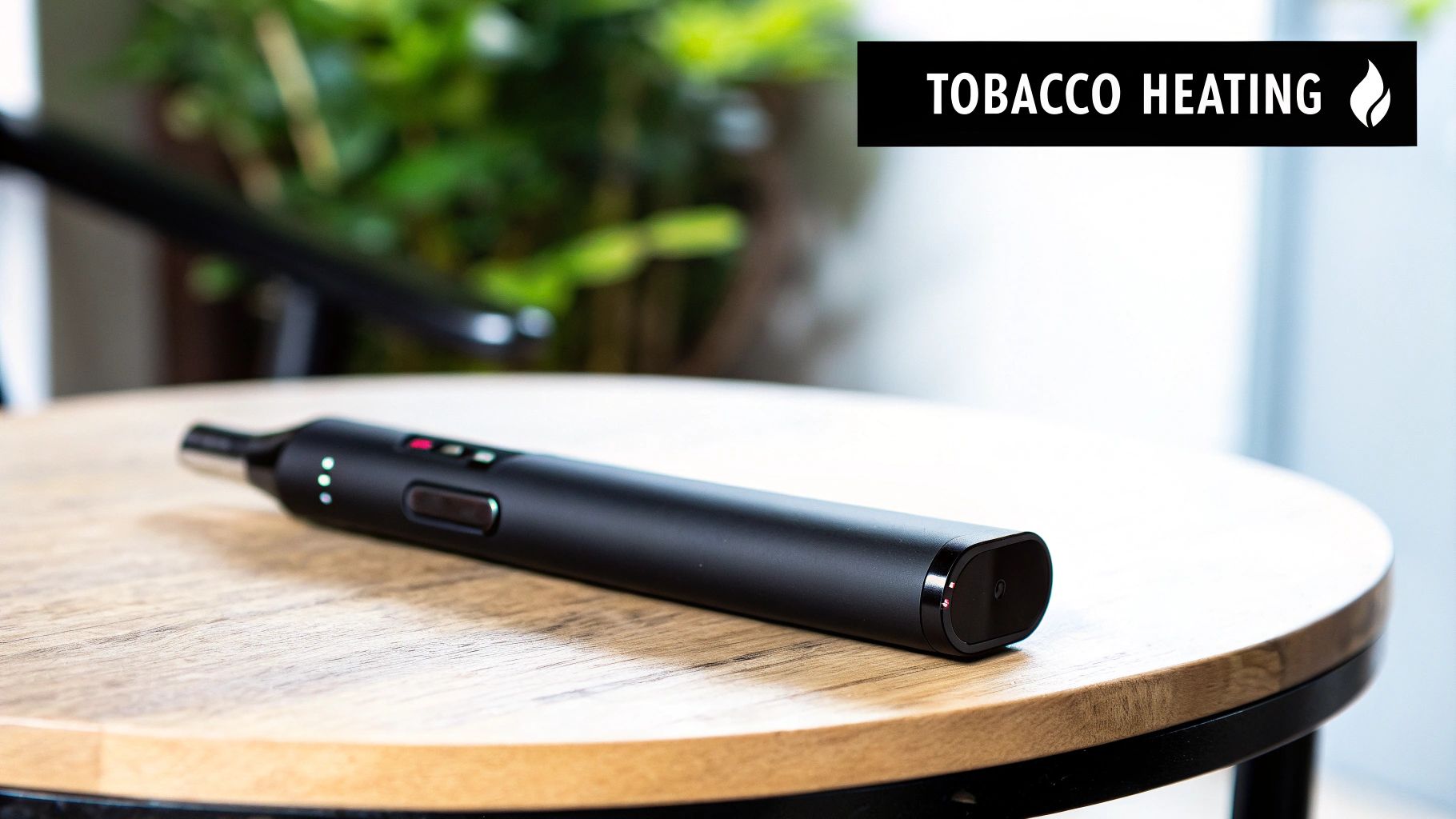
Think of a heated tobacco device as a clever little high-tech oven, designed specifically for tobacco. Instead of setting the tobacco on fire, it warms it up just enough to release a vapour that contains nicotine. This is the whole game-changer.
A traditional cigarette burns tobacco at scorching temperatures of over 600°C (1). These devices, on the other hand, gently heat custom-made tobacco sticks to around 350°C. That single difference—heating versus burning—is the core idea behind this technology.
Decoding Heated Tobacco Technology
Here’s an analogy. Imagine you want to cook a steak. You could blast it with a blowtorch, which would char the outside and create a whole lot of smoke. Or, you could pan-sear it with controlled, even heat to get all the flavour without the burnt bits. Cigarettes are the blowtorch method—combustion. This high-temperature burning is what creates smoke filled with thousands of chemicals, many of which are known to be harmful (2).
Heated tobacco products, often called 'heat-not-burn' devices, take the pan-searing approach. They’re built to control the temperature precisely. The tobacco gets just hot enough to release its flavour and nicotine in an aerosol (or vapour), but not hot enough to actually ignite. By avoiding combustion, the whole process sidesteps the primary source of the most dangerous stuff found in cigarette smoke.
The core principle here is harm reduction by getting rid of combustion. By heating tobacco instead of burning it, these devices aim to deliver a tobacco experience with significantly lower levels of harmful and potentially harmful constituents (HPHCs) compared to smoking a normal cigarette.
What Sets It Apart
It’s easy to get this mixed up with smoking or vaping, but it's really its own thing. While heated tobacco uses real tobacco leaf to create its vapour, it's definitely not a cigarette. And even though it produces a vapour, it's fundamentally different from an e-cigarette, which vaporises a nicotine-infused liquid. If you want to dive deeper into that, our guide explains in detail why heated tobacco products are not the same as e-cigarettes.
The experience sits somewhere in the middle ground, offering a pretty unique set of characteristics. The key differences really boil down to:
-
The Substance: Heated tobacco uses processed, real tobacco leaf. Vaping, on the other hand, uses e-liquid—a mix of nicotine, propylene glycol, vegetable glycerine, and flavourings.
-
The Process: It heats a solid material (the tobacco stick), while vaping turns a liquid into vapour.
-
The Flavour Profile: Most users describe the taste as a "toasted" or "roasted" tobacco flavour. It’s much closer to the taste of smoking than the often sweet and varied flavours you get with e-liquids.
Heated Tobacco vs Vaping vs Smoking At a Glance
To cut through the confusion, it helps to see everything side-by-side. Each of these nicotine delivery methods works on a completely different principle, which leads to a very different experience and, crucially, a different health profile. This table breaks down the essentials.
|
Attribute |
Heated Tobacco |
Vaping (E-Cigarettes) |
Conventional Cigarettes |
|---|---|---|---|
|
Primary Substance |
Real Tobacco Sticks |
Dried Tobacco Leaf |
|
|
Core Process |
Heating (No Combustion) |
Vaporisation |
Combustion (Burning) |
|
Byproduct |
Aerosol (Vapour) |
Aerosol (Vapour) |
Smoke and Ash |
|
Operating Temp. |
Approx. 350°C |
Approx. 200°C |
Over 600°C |
|
Flavour Source |
Toasted Tobacco |
Burnt Tobacco |
Seeing it laid out like this makes the distinctions much clearer. While all three deliver nicotine, the "how" is what really matters, affecting everything from taste to the chemical compounds you inhale.
How Heated Tobacco Technology Works
At its core, a heated tobacco system is a pretty clever bit of kit. It’s designed to do one job with pinpoint accuracy: heat tobacco, but not let it burn. This is a world away from simply lighting a cigarette with a flame. Instead, these devices use a controlled, electronic process to gently release the flavour and nicotine from real tobacco. That single difference—heating instead of burning—defines the entire experience.
Most of the heated tobacco products you'll see out there are built around three main parts that work together (3). Each bit has a specific job to do, ensuring you get a consistent experience every time.
-
The Holder: Think of this as the pen-shaped part you actually hold. It houses the battery, all the smart electronics, and the most crucial part: the heating element. It’s essentially the 'oven' of the whole system.
-
The Tobacco Stick: These might look like short, slim cigarettes, but they are specially made for heating. Inside, you’ll find a plug of processed, real tobacco leaf.
-
The Charger: This is usually a pocket-sized case that recharges the holder after you've used it, making sure it’s powered up and ready for your next session.
The Heating Mechanism Explained
The real magic happens inside the holder. When you push the button, it doesn't spark a flame. Instead, it activates a sophisticated heating element that makes direct contact with the tobacco stick. The leading brands tend to use one of two main methods to get this controlled temperature rise just right.
One common approach is the ceramic heating blade. This is a small, flat blade inside the holder that slides right into the centre of the tobacco stick. When you turn it on, an electric current warms the blade to a very precise temperature, typically around 350°C (4). The heat then radiates outwards, warming the tobacco from the inside out without ever setting it on fire.
Another, more advanced method is induction heating. With these devices, the holder generates a magnetic field. There's a tiny metal strip inside the tobacco stick itself that reacts to this field, causing it to heat up rapidly. This technique allows for incredibly precise and even heating right through the tobacco.
No matter the technology—whether it's a blade or induction—the aim is the same. The whole system is engineered to keep the temperature well below the 600°C point where tobacco starts to burn. This ensures the tobacco releases a nicotine-containing vapour, not smoke.
From Start to Finish: A User's Journey
Knowing the parts is one thing, but it’s much clearer when you see how they all work together in a typical session. It's a simple, almost ritualistic process that’s designed to feel both familiar and modern.

This quick visual shows just how straightforward it is. You prepare the device, let it heat up, and then you're ready to go.
The device's internal computer manages the whole thing. Let’s walk through the steps:
-
Insertion: First, you pop a specially designed tobacco stick into the holder. The device will often give a little vibrate or flash a light to let you know it's in correctly.
-
Activation: Next, you press and hold a button on the holder. This kicks off the heating cycle. The device will usually vibrate again and a light will start to pulse, showing it’s warming up. This normally takes about 20 seconds.
-
Ready Signal: Once it hits the perfect temperature, the device signals that it’s ready with another vibration and a solid light.
-
The Session: The experience is designed to last for a set amount of time, usually around six minutes or 14 puffs, which closely mimics the time it takes to smoke a traditional cigarette. This is all pre-programmed to keep things consistent.
-
Completion: As you get near the end of your session, the device will give you a final warning vibration. After the last puff, it automatically turns off the heating element.
-
Removal and Recharge: Finally, you take out the used tobacco stick. With most models, you then place the holder back into its portable charger to get it ready for next time.
This controlled, step-by-step process is miles away from the simple act of lighting up. It's this level of technological control that allows heated tobacco systems to consistently avoid combustion and manage the entire user experience from beginning to end.
The Health Impact of Heated Tobacco
When you're thinking about moving away from smoking, the first question is always about health. So, is heated tobacco actually safer? The whole conversation boils down to one key idea: harm reduction. The big difference here is the lack of combustion—the burning process that creates the vast majority of toxins in cigarette smoke.
By heating the tobacco to around 350°C instead of setting it alight at over 600°C, these devices create a nicotine aerosol, not smoke. This simple change is meant to drastically cut your exposure to many of the thousands of harmful and potentially harmful chemicals that are churned out every time you light a cigarette.
This distinction is the entire foundation of the "reduced risk" argument. Think about the difference between toasting a slice of bread and setting it on fire with a blowtorch. Both apply heat, but only one results in a charred, smoke-billowing disaster that isn't pleasant to eat. It’s a simple analogy, but it helps to explain why the chemical makeup of heated tobacco vapour is so different from cigarette smoke.
What The Health Experts Say
Major public health bodies here in the UK have been looking closely at the evidence to figure out where heated tobacco fits into the bigger picture. Their goal is to offer solid guidance for adult smokers searching for better alternatives. While they are rightly cautious, the findings consistently suggest these products have a reduced-risk profile compared to sticking with cigarettes.
For instance, UK health authorities like Public Health England (PHE) and the Office for Health Improvement and Disparities (OHID) have adopted a measured stance on heated tobacco. A landmark 2018 review pointed out that these products expose users to substantially lower levels of harmful chemicals than cigarettes, suggesting a reduced risk for smokers who switch over completely (5). Similarly, the UK Committee on Toxicity (COT) concluded that heated tobacco likely presents a lower health risk for smokers who make the full transition.
The scientific consensus is pretty clear: while not risk-free, switching completely from cigarettes to heated tobacco is likely to be significantly less harmful for adult smokers. It’s a harm reduction tool, not a health product.
It’s vital to remember that "reduced risk" doesn't mean "no risk." These products still contain nicotine, which is addictive, and they are only meant for current adult smokers. The aim isn't to create a new habit, but to move smokers away from the far greater dangers of burning tobacco.
Understanding The Risks That Remain
While the drop in many well-known toxins is a clear positive, the long-term health effects of using heated tobacco are still under the microscope. The technology is relatively new, so we simply don't have decades of data to draw on yet. The aerosol it produces still contains many of the same harmful compounds as tobacco smoke, just at much lower levels than you'd find in cigarette smoke.
Some studies have also flagged that certain compounds, not typically found in high amounts in cigarette smoke, can be present in heated tobacco aerosol. This just goes to show how complex these comparisons are and reinforces why these products should never be considered harmless. The conversation is always evolving as more independent research becomes available.
Making smart choices about your health is everything. Getting to grips with the real-world impact of products like heated tobacco highlights the wider importance of taking a proactive approach to your well-being through preventative healthcare.
Who Are These Products For?
This can't be stressed enough: heated tobacco devices are not for non-smokers, former smokers, or young people. They are designed specifically as an alternative for adult smokers who, for whatever reason, are not ready or able to quit nicotine altogether.
-
For the Smoker: The main advantage is a huge reduction in exposure to the toxic chemicals created by burning.
-
For the Non-Smoker: Starting any nicotine product, including heated tobacco, introduces health risks where there were none before. It’s a non-starter.
When you stack heated tobacco against other alternatives, the results can vary from person to person. Many smokers, for instance, have found huge success with vaping, and there’s a mountain of evidence showing that e-cigarettes are highly effective quit-smoking aids. The "best" choice is always the one that helps an individual stop smoking cigarettes for good.
Heated Tobacco vs Vaping and Smoking
If you're thinking about moving on from cigarettes, getting your head around the real-world differences between heated tobacco, vaping, and smoking is the first step. Each one offers a totally different experience, from the daily ritual and flavour to the long-term cost and how people see them. Figuring out the right path is all about what you're looking for personally and your goals for reducing harm.
The biggest difference usually boils down to what you're actually using. Heated tobacco systems use real, processed tobacco leaf, which gives a flavour that many smokers find instantly familiar. This "toasted" tobacco taste can make the switch feel a lot more natural because it's so close to the sensory experience they're used to, just without the harshness of actual smoke. This method does mean that you are at risk from heavy metals such as lead, cadmium and arsenic, and other substances that the tobacco plant pulls out of the ground (6).
Vaping, on the other hand, uses e-liquid, which contains no tobacco whatsoever. This blows the doors wide open to a massive world of flavour possibilities, from classic tobacco and menthol to an endless list of fruit, dessert, and drink-inspired choices. For anyone wanting to get away from the taste of tobacco completely, vaping offers a variety that heated tobacco just can't touch.
Ritual and User Experience
How you use these products day-to-day also sets them apart. Smoking has a simple, if destructive, ritual: light up, smoke, done. Heated tobacco systems copy this with a modern spin – you pop in a tobacco stick, wait a few seconds for the device to heat up, and then use it for a set time, much like a single cigarette.
Vaping is a bit more flexible. You can take a few puffs whenever you feel like it and then just put the device away. This "pick up, put down" convenience is a big draw for people who want more control over their nicotine intake throughout the day, rather than being locked into a full session.
For many long-term smokers, the familiar ritual is a major part of the habit. The structured, session-based nature of heated tobacco can feel closer to the experience of smoking a cigarette than the more continuous, on-demand nature of vaping.
Health and Harm Reduction
This is where the comparison gets really important. Traditional smoking, with its combustion, is without a doubt the most harmful option, releasing thousands of toxic chemicals when you light up. Both heated tobacco and vaping work on the principle of harm reduction by getting rid of the burning process.
Heated tobacco does significantly cut down your exposure to the harmful chemicals found in cigarette smoke, but it’s crucial to know that it's not risk-free. Some studies suggest its aerosol contains different compounds and might have its own set of health risks that are still being looked into, some indicate that combustion is still occurring in heated tobacco products, and others indicate that the risk of harm is lower than traditional cigarettes but higher than E-Cigarettes. The experience is different from vaping, and our guide on the health benefits of vaping compared to smoking gives more context on where e-cigarettes stand in the harm reduction picture.
Vaping is widely considered by UK public health bodies to be substantially less harmful than smoking. As e-liquids don't contain any tobacco, their vapour is free from many of the cancer-causing agents created when tobacco is burned, or even just heated.
Cost and Social Acceptance
From a financial point of view, both heated tobacco and vaping will save you a lot of money compared to smoking. You'll need to buy a device to get started, but the ongoing cost of the consumables – whether that's tobacco sticks or e-liquid – is much lower than constantly buying packs of cigarettes.
Socially, things are changing too. The smell of cigarette smoke clings to everything and is a huge negative for smokers and non-smokers alike. Heated tobacco produces a much milder smell that doesn't hang around. Vaping goes one better, with vapour that disappears almost instantly and often has a faint, pleasant scent, depending on the flavour. This makes both options far more discreet and considerate to use around other people.
The UK Heated Tobacco Market Explained
In the UK’s bustling nicotine scene, where vaping has long been king, heated tobacco is quietly carving out its own space. It offers a different kind of alternative for adult smokers, finding a middle ground between the timeless ritual of smoking and the modern tech of an E-Cigarette.
It hasn't had the same explosive growth as vaping, but the market is definitely not standing still. Heated tobacco is expanding at a steady pace as more smokers discover it as another option on their journey away from cigarettes. This growth is fuelled by big brands launching their latest devices and a gradual, but consistent, rise in consumer interest.
This slow-and-steady growth is showing up in the numbers, too. The UK market is on track to hit £448 million by 2025, which is a 5% increase on the previous year. Still, it’s a much smaller player compared to the vaping giant, which boasts over 5.5 million adult users in the UK — that’s more than ten times the number of people using heated tobacco. If you want to dive deeper into the figures, you can explore the full heated tobacco market snapshot.
Who Is Using Heated Tobacco in the UK?
So, who are these devices actually for? The data paints a pretty clear picture. The main audience for heated tobacco in the UK is current adult smokers who are actively looking for a better alternative to traditional cigarettes.
Awareness has certainly shot up over the last few years. Back in 2017, only a tiny fraction of adults had even heard of these products. Now, that figure has climbed to nearly a third of the population, with awareness especially high among younger adults aged 18-39.
Knowing about it doesn't always lead to trying it. The number of regular users is still pretty small, making up less than 1% of all adults. The most important takeaway is that use is almost exclusively among people who already smoke or used to smoke, cementing its role as a product for switching, not starting.
The user profile is quite specific: heated tobacco tends to click with adult smokers who miss the real tobacco flavour and the familiar, session-based experience of a cigarette. It is not designed for non-smokers or young people.
Navigating the Regulatory Landscape
The UK has taken a unique path when it comes to regulating heated tobacco, setting it apart from the rules for both cigarettes and vapes. This directly affects how these products are sold and marketed.
-
Taxation: The tobacco sticks are taxed under their own special category. This makes them significantly cheaper than cigarettes, but a bit pricier than most e-liquids.
-
Advertising: While you can’t advertise cigarettes at all, heated tobacco has fewer restrictions. This allows for more marketing in shops and online, making the products more visible to adult smokers.
-
Health Warnings: The packaging must have text-based health warnings, but they aren't required to display the graphic, pictorial warnings you see on cigarette packs.
This unique regulatory position helps present heated tobacco as a distinct choice for adult smokers. The rules seem designed to acknowledge its potential for harm reduction compared to smoking, while still keeping a tight rein on promotion to stop non-smokers from picking it up. It's a balanced approach that shapes its place in the UK's public health strategy—one of several tools to help smokers finally leave combustion behind.
Heated Tobacco FAQ
As we've journeyed through the world of heated tobacco, from its core technology to its spot in the UK market, you're probably left with a few practical questions. It's only natural. To help round things out, this section tackles the most common queries we hear, giving you direct, clear answers to help you make a fully informed choice.
Is Heated Tobacco Cheaper Than Smoking in the UK?
Yes, in the long run, heated tobacco generally works out to be more economical than smoking traditional cigarettes. You do have an initial investment in the device itself, but the real savings come from the ongoing cost of the specially designed tobacco sticks.
A pack of these sticks usually costs about half the price of a standard pack of 20 cigarettes here in the UK. For a regular smoker, the savings on these consumables quickly add up and will easily offset what you paid for the device upfront. For many adult smokers, this makes switching to heated tobacco a financially smarter decision over time.
What Does Heated Tobacco Taste and Smell Like?
As heated tobacco uses real, processed tobacco leaf, the flavour is often described as a 'toasted' or 'roasted' tobacco taste. It’s a profile that’s much closer to the authentic experience of smoking than many other alternatives, but without the harshness that comes from actually burning it. This provides that familiar sensation many smokers are looking for.
A massive advantage is the smell—or rather, the lack of it. The aerosol produced has a very mild scent that vanishes almost instantly. Unlike cigarette smoke, it does not cling to your clothes, hair, or furniture, which is a huge benefit for both users and the people around them.
The distinct lack of lingering odour is one of the most frequently praised features of heated tobacco. It allows for a more discreet experience that doesn't leave a lasting trace in your home, car, or on your person.
Many brands also offer different flavour variations to cater to a wider range of preferences, including menthol and other aromatic blends, giving you more choice beyond the classic tobacco taste.
Can I Use Regular Cigarettes in a Heated Tobacco Device?
That’s a definite no. You must never, ever attempt to use a conventional cigarette in a heated tobacco device. These systems are precision-engineered to work exclusively with their own branded tobacco sticks, like HEETS or neo sticks.
These purpose-built sticks have a very specific design, density, and moisture level that is essential for the heating process to work correctly. Trying to jam a regular cigarette in there simply won't work, could cause permanent damage to the delicate heating element, and might even be unsafe. Always stick to the manufacturer-approved sticks for your device.
Are Heated Tobacco Products Legal to Use Indoors in the UK?
The legal situation here is a bit nuanced and often misunderstood. The UK's nationwide smoking ban applies specifically to combustible tobacco smoke, but because heated tobacco supposedly produces an aerosol or vapour, not smoke, it isn't technically covered by that same piece of legislation.
However, this absolutely does not mean you have a free pass to use it anywhere you like. The vast majority of private businesses, employers, and public transport operators include heated tobacco products within their broader "no smoking or vaping" policies.
As a rule of thumb, you should always assume you cannot use your device indoors unless you have been given explicit permission. It's always best to check the specific rules of the venue to avoid any awkward situations.
How Popular is Heated Tobacco?
While it's certainly gaining traction, heated tobacco is still a bit of a niche product in the UK, especially when compared to vaping. Awareness has grown significantly, jumping from just 9% of adults in 2017 to 28% more recently. This recognition is even higher among younger adults, with 37% of those aged 18-24 aware of the products.
Despite this growing awareness, actual use remains quite low. Only about 0.7% of adults, which is around 400,000 people, are regular users, a figure that has stayed pretty stable. Among current smokers, the numbers are more promising, with 14% having tried heated tobacco products and half of them being aware they exist. For a deeper dive into these trends, you can learn more about heated tobacco use in the UK on ASH.org.uk.
This data shows that while it’s not yet mainstream, heated tobacco is establishing itself as a recognised alternative for existing smokers. For those weighing their options, understanding how other harm reduction tools stack up can be helpful. You might be interested in this study proving e-cigarettes help people quit smoking to compare different approaches.
A Guide To Heated Tobacco Products - Conclusion
At SMOKO, we are committed to helping adult smokers find realistic and effective alternatives to cigarettes. For over 12 years, our UK-made e-liquids and easy-to-use vaping devices have helped countless customers on their journey to becoming smoke-free.
We believe in moving away from tobacco products - while heated tobacco products may be a stepping stone in the right direction for smokers, it may also be easy to fall back into old habits if you run out of your heated tobacco sticks or the heating device fails and you are caught without. By moving to E-Cigarettes, it creates distance between you and tobacco, making a move back to any tobacco-containing product seem like a big step in the wrong direction.
So - if you are a smoker who is ready to make a change, be sure to check out our FREE* starter kit deals at https://smoko.com!
References
(1) American Association for Cancer Research - On the Burning Temperatures of Tobacco
(2) American Cancer Society: Harmful Chemicals in Tobacco Products
(3) ResearchGate - Parts of a heated tobacco system
(4) Heated Tobacco Products: Insights into Composition and Toxicity
(5) Evidence review of e-cigarettes and heated tobacco products 2018: executive summary
(6) FDA: Chemicals in Every Tobacco Plant
ABOUT THE AUTHOR
Written by Dan Overgage
Dan Overgage is a former smoker of 10 years until he became a client of SMOKO E-Cigarettes. Dan started working with SMOKO 5 years ago after successfully quitting using our e-cigarettes and works across our Customer Service and heads up our content creation and research with a strong focus on all things quitting smoking. During his tenure with SMOKO, Dan has written countless blogs and consults with countless clients every day to help them to stay smoke-free.
Last updated 10/09/2025