Table of Contents
- Key Takeaways
- Why Quitting Smoking Alone Is So Hard
- How Support Groups Can Tip the Scales in Your Favour
- Finding The Right Support Group For Your Needs
- Comparing The Different Group Styles
- The Rise Of Digital Support Networks
- Making The Right Choice For You
- How Modern Quitting Aids Fit into Your Journey
- The Rise of E-Cigarettes as a Quitting Tool
- Bringing Aids and Group Support Together
- Don't Forget the Tried and True
- Taking the First Step: How to Find and Join a Support Group
- How to Get the Most from Your Support Group
- Common Questions About Support Groups
- What If I’m Too Anxious to Speak in a Group?
- Are Smoking Cessation Support Groups Free in the UK?
- What Happens If I Relapse While in the Group?
- Do I Have to Use Other Aids to Join?
- Join Smoking Cessation Support Groups & Quit Successfully - Conclusion
- Frequently Asked Questions
- References
Key Takeaways
-
Boost Your Success Rate – Joining a smoking cessation support group significantly increases your chances of quitting compared to going it alone.
-
Stay Motivated – Support groups provide encouragement, accountability, and practical tips from people who understand the challenges of quitting.
-
Build Lasting Change – Sharing your journey in a supportive environment helps you manage cravings, avoid relapse, and maintain a smoke-free lifestyle.
Trying to quit smoking is a tough business, one of the hardest things a person can do. It often feels like you're fighting a lonely, uphill battle against something much bigger than you. You're not just dealing with nagging physical cravings; you're also wrestling with deeply ingrained habits. Going it alone is incredibly difficult, which is precisely why smoking cessation support groups can be a game-changer. They offer that shared strength when your own willpower starts to waver. The right tools - like the right E-Cigarette Starter Kit and Nicotine Gum - are essential for improving quit rates.
Why Quitting Smoking Alone Is So Hard
Picture this: you've decided to quit. It's like standing at the bottom of a huge, steep mountain. You can see the peak—that healthier, smoke-free version of yourself—but the path is a minefield of challenges. When you try to make that climb by yourself, you're banking everything on your own resolve, and that can feel like a pretty flimsy defence against the sheer force of nicotine addiction.
The physical fight kicks off almost immediately. Just a few hours after your last cigarette, nicotine withdrawal starts to set in. This isn't just a mild inconvenience; it's an onslaught of intense cravings, irritability, anxiety, and brain fog that can knock even the most determined person off course. (1)
The Mental and Emotional Hurdles
Beyond the purely physical side, there’s the psychological battle, which is often even tougher. Smoking weaves itself into the very fabric of your daily routine. That first coffee in the morning, the break at work, the ritual to unwind at the end of the day—all of these become powerful triggers, constantly reminding you of a habit that’s been a loyal companion for years. (2)
When you're quitting on your own, you have to face every single one of those triggers without a safety net. This sense of isolation can make stress and feelings of loss feel ten times worse, making it dangerously easy to convince yourself that just one cigarette would make it all better. It’s this mental warfare that trips most people up. Sometimes, major events in our lives can present both new challenges and a unique chance to quit, an idea we explore in our guide on how people used lockdown to quit smoking.
Quitting isn't just about willpower. It’s about completely rewiring your brain and rebuilding your life, all while battling a powerful chemical dependency.
The Power of a Shared Journey
Let's go back to that mountain climbing analogy. Sure, a seasoned climber might be able to get to the top alone, but their chances of success—and safety—skyrocket when they're with a team. Fellow climbers shout encouragement, guides share proven techniques, and just knowing you're not alone provides an incredible psychological boost.
A smoking cessation support group does the exact same thing. It turns quitting from a solitary struggle into a team effort. It gives you:
-
Shared Experience: You're suddenly in a room (real or virtual) with people who get it. They know exactly what you’re feeling because they’re feeling it too.
-
Practical Advice: Forget generic tips. You get real-world advice from people who have found what actually works for managing cravings or dealing with a party.
-
Accountability: Just knowing you have to check in with the group can be the extra push you need to resist a craving in a moment of weakness.
At the end of the day, quitting alone means you have to be your own coach, cheerleader, and medic all at once. Joining a support group gives you a whole team to play those roles, making the journey far less intimidating and your chances of success so much higher.
How Support Groups Can Tip the Scales in Your Favour

So, what exactly is a smoking cessation support group? Forget any idea of a stuffy, formal lecture. It's much more like a team huddle before a big game—a community of people all pulling in the same direction, aiming for the same goal: a life without cigarettes.
Quitting can feel incredibly lonely. A support group changes that dynamic completely. Instead of battling a craving by yourself, you’re suddenly connected to a room full of people who know exactly what you’re going through. That shared experience is the bedrock of why they work.
The Winning Formula for Quitting
Trying to quit with willpower alone is like trying to bake a cake with just flour. It's an important ingredient, but you need more to get the job done. A support group adds all the other crucial elements you need for a successful result.
You get a potent mix of practical advice and emotional backup that you just can’t get on your own. It’s this combination that builds your defences against the powerful physical and psychological grip of nicotine.
Here’s what you’ll find inside:
-
Real Encouragement: This comes from people who genuinely get it. When you’re having a bad day and feel like giving in, you’re met with nods of understanding, not judgement. That validation is a game-changer.
-
Built-in Accountability: Just knowing you'll be sharing your progress—and your slip-ups—adds a bit of positive pressure. It’s a gentle nudge that can make all the difference on those really tough days.
-
A Shared Box of Tricks: Members trade real-world tips on how to handle triggers. You'll hear how someone else finally managed their morning coffee without a cigarette or navigated a stressful day at work without reaching for a pack.
A Team Effort Where Everyone Plays a Part
Joining a smoking cessation support group is like being part of a team where everyone is invested in seeing you win. The person who quit yesterday has just as much to offer as someone who's been smoke-free for years. A newcomer's raw experience reminds long-term members how far they've come, while the veterans offer proof that it can be done.
Quitting smoking is often seen as a lonely battle of willpower. A support group turns it into a shared journey, where your vulnerability becomes the very thing that connects and strengthens everyone in the room.
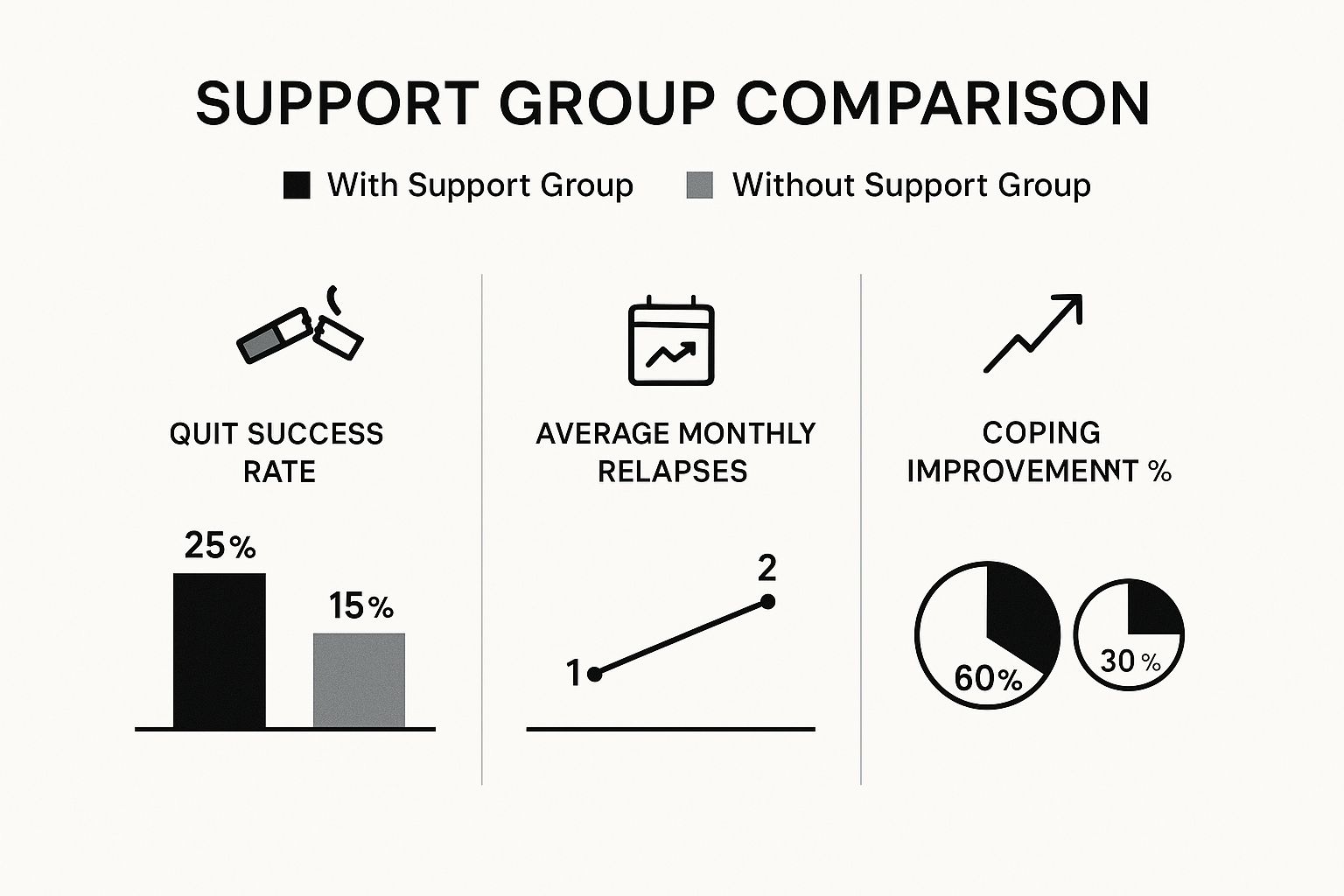
This whole environment shifts the odds in your favour. Research from the UK on group behaviour therapy really backs this up. Studies have found that smokers who attend six to eight group sessions are nearly twice as likely to quit as those just using self-help books, bumping success rates from around 5% up to 9% (3). You can read more about these group therapy findings and see the difference it makes.
This collective strength acts as a safety net. When your personal motivation wavers, the group's energy can pull you through. It’s this spirit of collaboration that makes quitting not just more bearable, but far more likely to stick for good. You're no longer fighting an addiction alone; you're part of a united front.
Finding The Right Support Group For Your Needs
Choosing a smoking cessation support group is a lot like finding the right personal trainer. There’s no single ‘best’ option that works for everyone. The right fit comes down to your personality, your lifestyle, and what truly motivates you. Your success really depends on finding a community where you feel comfortable, understood, and genuinely supported on your own terms.
It's important to realise that not all support groups are run the same way. Some are quite structured and led by healthcare professionals, while others are built on the casual, informal support of people who've been exactly where you are now. Getting to grips with these differences is the first real step toward making a choice that you’ll stick with.
Comparing The Different Group Styles
Let's break down the main types of support you’ll come across. Think of it as comparing different routes to the same destination—each path has its own scenery and bumps in the road, but they can all lead you to a smoke-free life.
The two most common approaches you'll find in the UK are professionally-led services and peer-support networks.
-
NHS Stop Smoking Services: These are typically structured, evidence-based programmes run by trained advisors. They're fantastic if you appreciate a clear plan, expert guidance, and access to approved quitting aids like nicotine replacement therapy (NRT). The focus is squarely on practical strategies and techniques for changing your behaviour.
-
Nicotine Anonymous (NA): This is a peer-led fellowship, modelled on the well-known 12-step programme (4). The atmosphere here is less clinical and leans more into shared personal stories, mutual encouragement, and finding strength as a group. It’s an excellent choice if you thrive on deep personal connections and a community-driven approach to recovery.
To put it another way, an NHS group is like a structured class with a teacher, whereas Nicotine Anonymous is more like a supportive club where everyone chips in to help each other. Neither is better than the other; they just serve different needs.
The Rise Of Digital Support Networks
Beyond the traditional face-to-face meetings, the options for online support have exploded. These digital communities offer a level of flexibility that can be a real game-changer for people with hectic schedules, mobility issues, or for those who just feel more comfortable opening up from home.
Online forums, dedicated apps, and social media groups give you 24/7 access to encouragement. You can post a message in the middle of a late-night craving and get a supportive reply within minutes. That kind of immediate, accessible help can be incredibly powerful in those tough moments. For many, pairing these online groups with modern quitting aids is a highly effective strategy. You can learn more about this by reading our guide on using e-cigarettes to help you stop smoking.
The image below shows just how powerful joining any form of support group can be for your quitting journey.
Making The Right Choice For You
So, how do you decide which is the one for you? It helps to take an honest look at your own personality and preferences. To help you weigh your options, this table breaks down the different formats.
Comparing Smoking Cessation Support Group Formats
This table compares the key features of different support group types to help you decide which one best suits your needs and preferences.
|
Group Type |
Best For |
Key Benefit |
Potential Drawback |
|---|---|---|---|
|
In-Person (Professional) |
Individuals who prefer structure, expert advice, and a clear, evidence-based plan. |
Access to trained professionals and approved quitting aids (like NRT). |
Can be less flexible with fixed meeting times and locations. |
|
In-Person (Peer-Led) |
Those who value shared experiences, emotional connection, and community support. |
Strong sense of camaraderie and understanding from others who've been there. |
Less structured; success depends heavily on the group dynamic. |
|
Online (Forums/Apps) |
People with busy schedules, those in remote areas, or anyone who prefers anonymity. |
24/7 access to support from anywhere, offering immediate help during cravings. |
Lacks face-to-face connection, which can be crucial for some people. |
Ultimately, the best choice depends on what you feel will keep you engaged and motivated.
If you thrive on structure and expert advice, exploring your local NHS services is a brilliant place to start. If, however, you feel that sharing your story with others who have walked the same path is more your style, a peer-led group like Nicotine Anonymous might be a perfect match.
And if your schedule is all over the place, a flexible online forum could provide the consistent support you need, whenever you need it. The real goal is to find your team—the people who will make your journey to becoming smoke-free feel like a collective victory.
How Modern Quitting Aids Fit into Your Journey

The world of quitting smoking has changed. While that fundamental need for human connection hasn't gone anywhere, the tools we can use to get the job done have grown dramatically. Understanding how these modern aids fit into your plan—especially alongside a smoking cessation support group—can be a real game-changer.
Think of it like this: your support group is the foundation and the blueprint for your smoke-free life. It provides the structure, the accountability, and the shared wisdom that keeps you steady. Modern aids, like nicotine replacement therapy (NRT) or E-Cigarettes and vapes, are the specialised power tools that make the day-to-day construction bearable.
These aids aren’t meant to replace the human element. They’re designed to work in tandem with it, tackling the fierce physical cravings that can so easily sabotage your progress. By getting those withdrawal symptoms under control, you free up mental and emotional energy to actually engage with your support network and work on the deeper psychological side of quitting.
The Rise of E-Cigarettes as a Quitting Tool
It’s impossible to ignore the massive shift towards e-cigarettes as a tool for smokers in England looking to quit. They've gone from being a niche product to a mainstream method for managing nicotine while stepping away from combustible tobacco for good.
This isn't just a feeling; the numbers back it up in a big way. E-cigarettes are now, by far, the most popular aid used by people trying to quit in England.
In fact, a major survey from 2023-2024 showed that an incredible 40.2% of all quit attempts involved using an e-cigarette (5). What’s more, the study also found that they were linked with the highest quit smoking success rates, performing better than prescription drugs and even standalone behavioural support. You can dive into the full findings on how e-cigarettes are changing cessation outcomes to see the data for yourself.
Bringing Aids and Group Support Together
Using an aid like an E-Cigarette doesn’t mean you’re flying solo. It just means you’re arming yourself properly for the battle ahead. When you combine this practical tool with the solidarity of a smoking cessation support group, you create a powerful, two-pronged attack.
Here’s a look at how they perfectly complement each other:
-
The Physical Fight: Your quitting aid (whether it's a vape, a nicotine patch, or gum) goes to work on the physical addiction, dialling down the intensity of withdrawal symptoms like irritability and maddening cravings.
-
The Mental Game: Your support group builds the emotional resilience you need to handle triggers, celebrate milestones, and find the motivation to keep going when things get tough.
-
The Practical Strategy: The group becomes a brilliant sounding board for real-world advice on using your chosen aid—from tips on when to use it most to strategies for eventually tapering off.
This combined approach makes sure you have all your bases covered: the chemical dependency and the ingrained behavioural habits.
The most effective quitting plan isn't about choosing between a modern aid or a support group. It's about recognising that the journey has both physical and emotional challenges, and using the best tool for each.
Don't Forget the Tried and True
While new tools have taken centre stage, we shouldn't overlook the enduring value of established programmes like the NHS Stop Smoking Services. It's true that fewer people use these services now than a decade ago, but for those who do commit, the success rates are still impressively high.
This just proves a timeless principle: engaged, structured support works. Whether you lean on a modern aid, a traditional service, or a peer-led group, the core ingredients for success remain the same—commitment, shared experience, and genuine accountability. The quitting landscape will continue to evolve, but that human need for support will always be the most powerful tool in the arsenal.
Taking the First Step: How to Find and Join a Support Group
https://www.youtube.com/embed/CRQl6llr1lY
Deciding to join a smoking cessation support group is a massive step in the right direction, but it's natural to feel a bit unsure about where to begin. It's often the 'how' that stops us. Don't worry, the process is far less intimidating than it seems. This guide will show you exactly how to find the right group for you in the UK, turning a daunting task into a series of simple, manageable actions.
Think of it like finding a new gym or a hobby club. You wouldn't just walk into the first one you see; you'd look around, see what fits your style, and ask a few questions. The same logic applies here, and thankfully, there are some brilliant resources ready to help.
Where to Start Looking
In the UK, you don’t need to trawl through endless search results to find help. The best place to start is with established, trusted organisations that have a proven track record of supporting people just like you.
Here are your two best starting points:
-
The NHS Stop Smoking Service: This is the go-to resource for expert-led support in the UK. It’s free, it’s local, and it’s run by professionals. They offer everything from one-on-one advice to group sessions. The easiest way to get started is by using the official NHS service finder to see what's on offer in your area.
-
Nicotine Anonymous (NicA): If you'd feel more comfortable in a group led by people who have been through it themselves, NicA is a fantastic option. It's a community built on shared experience and mutual encouragement. You can find a meeting near you by visiting the Nicotine Anonymous UK website.
Between these two, you'll find a great cross-section of what's available—from structured, professional programmes to more informal, peer-driven communities. Take a look at both to see which approach feels right for you.
Asking the Right Questions Before You Commit
Once you've found a couple of promising options, it’s a good idea to dig a little deeper. You're not being difficult; you're just making sure you find a space where you’ll feel comfortable and supported. A little bit of homework now can make all the difference later.
Finding the right group is less about which one is "best" and more about which one is best for you. A group's philosophy and structure should make you feel empowered, not intimidated.
Before you join, try to get answers to these key questions:
-
What's the overall approach? Is it a structured, behavioural programme like the ones the NHS runs, or is it more of a peer-led fellowship like Nicotine Anonymous? Understanding the group's core philosophy is the most important thing.
-
Who runs the meetings? Are they led by a trained counsellor or healthcare professional, or are they facilitated by fellow members on their own quit journey? There's no right or wrong answer, just what works for you.
-
What's the time commitment? How often do they meet, and for how long? Be realistic about what you can fit into your schedule.
-
Are other quitting aids welcome? Does the group support members who use things like nicotine replacement therapy (NRT) or e-cigarettes? It’s good to know if their stance aligns with your own quit plan. You can explore different products and aids to help you quit smoking to see what other options are out there.
By taking these simple steps, you strip away the uncertainty and anxiety. A bit of research and a few thoughtful questions will help you confidently find a smoking cessation support group that can become one of your most powerful tools on the road to a smoke-free life.
How to Get the Most from Your Support Group
Joining a smoking cessation support group is a brilliant first step, but how you show up makes all the difference. Just being in the room is a start, but active, committed participation is what turns a weekly meeting into your secret weapon for staying smoke-free for good.
Think of it like getting a gym membership. You won’t see results just by walking through the door. You have to pick up the weights, join a class, and actually do the work. The same is true here – diving in headfirst unlocks the real power of the group.
Be an Active Participant
Real engagement is about give and take. It means listening intently to others' stories just as much as it means sharing your own. When you truly listen, you’ll pick up clever coping strategies and, most importantly, realise you’re not the only one going through the tough stuff.
Opening up about your own journey—the good, the bad, and the ugly—is just as vital. It helps you make sense of your own progress and can be the exact piece of encouragement someone else in the room needs to hear. This back-and-forth support is what builds a powerful, effective community. To really cement your new smoke-free life, it helps to understand wider strategies for building healthy habits that can support your journey.
Set Small Goals and Find a Partner
Rather than staring at the huge mountain of "quitting forever," work with your group to set small, manageable goals each week. Maybe your goal is to get through the weekend pub trip without a cigarette, or to try a five-minute breathing exercise when stress hits. Celebrating these mini-wins together creates momentum and keeps everyone’s spirits up.
Finding an accountability partner in the group can also be a game-changer. This is your go-to person for a quick text or call when a craving feels overwhelming. Knowing you have someone in your corner who gets it can be the lifeline you need in a moment of weakness.
A slip-up isn’t a failure—it’s feedback. Treat it as a chance to learn more about your personal triggers. Bring that experience back to your group, and together, you can come up with a better plan for next time.
The proof is in the consistency. Just look at the success of programmes like those offered by the NHS. While fewer people may be using them these days, the quit rate for those who commit remains impressive, holding steady at 53.8% in 2023/24. It just goes to show that sticking with a supportive community is one of the most reliable ways to quit for good. You can find more data on NHS smoking cessation services and see the impact for yourself.
Common Questions About Support Groups

Even when you’re sold on the benefits, deciding to actually join a smoking cessation support group can feel like a huge step. It's only natural to have a few last-minute questions and doubts bubbling up. Let's tackle some of those common worries head-on, so you can walk into your first meeting feeling prepared and confident.
Knowing what to expect can really take the edge off.
What If I’m Too Anxious to Speak in a Group?
This is easily the biggest concern for most people, so if you're feeling this way, you're in good company. The good news is that any decent support group is a no-pressure zone. You will never be forced to speak.
In fact, for your first few visits, just listening is more than enough. Hearing other people share their own struggles and successes can be incredibly powerful all by itself. As you start to feel more comfortable and realise it's a safe, non-judgemental space, you might just find the words start to come naturally.
And if the idea of speaking out loud is still a deal-breaker? No problem. You could try:
-
Online forums: Text-based chats let you share your thoughts without saying a word.
-
Email support: Some groups offer support via email, giving you plenty of time to gather your thoughts before hitting send.
It's all about finding what works for you, not pushing yourself into something that causes more stress.
Are Smoking Cessation Support Groups Free in the UK?
Absolutely. The vast majority of smoking cessation support groups in the UK won't cost you a penny. This is a massive plus, as it means cost is one less barrier standing in your way.
The local NHS Stop Smoking Services are a cornerstone of this, offering expert help completely free of charge. You'll also find that brilliant peer-led communities like Nicotine Anonymous run on voluntary donations – you're never obligated to pay. While you can find private therapists who charge a fee, there are more than enough top-quality free options to get you started.
What Happens If I Relapse While in the Group?
A relapse can feel like a total failure, but inside a support group, it's treated for what it is: a stumble, not a fall. This is where the true power of a group shines through. Instead of facing that setback on your own, you have a room full of people ready to help you back up without an ounce of judgement.
A relapse isn't a sign that you've failed. It's just part of the messy, human process of quitting. Your group acts as a safety net, helping you figure out what went wrong and how to build a stronger plan for next time.
The group will help you unpick what triggered the slip-up and brainstorm new ways to handle that situation in the future. Their encouragement can be the vital push you need to get straight back on your quit journey.
Do I Have to Use Other Aids to Join?
Not at all. There are no strings attached. While many people find that combining a support group with things like Nicotine Replacement Therapy (NRT) or an e-cigarette gives them a real boost, it's never a requirement for entry.
Most groups welcome all quitting methods because the focus is on one thing: the shared goal of living smoke-free. You get to choose the path that feels right for you, and the group will be there to cheer you on every step of the way.
Join Smoking Cessation Support Groups & Quit Successfully - Conclusion
At SMOKO, we know that having the right tools can make all the difference for your quit smoking journey, and there is no better time to quit smoking than today!
Our UK-made E-Cigarettes and Vapes are designed to provide a realistic and satisfying alternative for adult smokers. We also have a range of sugar-free Nicotine Gum to cover all the bases!
When you pair an effective tool with the incredible power of a support group, you're giving yourself the best possible chance to finally quit for good. Explore our range at https://smoko.com and start building your support system today.
Frequently Asked Questions
1. What is a smoking cessation support group?
A smoking cessation support group is a community of people who are also trying to quit smoking. Meetings are usually guided by a facilitator and provide encouragement, tips, and shared experiences to help you stay motivated.
2. Do support groups really help you quit smoking?
Yes. Research shows that people who join support groups are more likely to quit successfully than those who try alone. The combination of accountability, encouragement, and practical strategies makes a big difference.
3. How do I find a support group near me?
You can ask your GP, check local health centres, or search online for NHS services and community groups. Many also offer virtual sessions if you prefer online support.
4. What happens in a typical meeting?
Meetings often include sharing personal experiences, discussing challenges, learning coping strategies, and celebrating progress. The atmosphere is supportive and non-judgmental.
5. Can I join if I’m still smoking?
Absolutely. Support groups welcome people at every stage of quitting. Even if you haven’t quit yet, attending can give you the tools and encouragement you need to get started.
References
(1) CDC: 7 Common Withdrawal Symptoms
(2) Smokefree.gov: Know Your Triggers
(3) Cochrane: Do group-based smoking cessation programmes help people to stop smoking?
(4) Nicotine Anonymous UK: The Official Nicotine Anonymous United Kingdom Website
(5) Prevalence of Popular Smoking Cessation Aids in England and Associations With Quit Success
ABOUT THE AUTHOR
Written by Dan Overgage
Dan Overgage is a former smoker of 10 years until he became a client of SMOKO E-Cigarettes. Dan started working with SMOKO 5 years ago after successfully quitting using our e-cigarettes and works across our Customer Service and heads up our content creation and research with a strong focus on all things quitting smoking. During his tenure with SMOKO, Dan has written countless blogs and consults with countless clients every day to help them to stay smoke-free.
Last updated 28/08/2025